What is B2B finance and how does it work?
October 22, 2026
-
0
min read
0
min read
B2B finance is any finance involved when one business sells to another, and the phrase points two ways at once. Usually it means borrowing, because money is going out of your business before the customers who owe you have paid. Sometimes it means the opposite: letting your own business customers pay later. Those are two different problems with two different sets of products, and mixing them up sends you to the wrong provider.
B2B stands for business to business, so B2B finance describes who is involved rather than a product you can apply for. Four quite different things get called by that name.
You want to borrow. Your business needs money, and the reason is usually timing. You've delivered the work, the invoice is out, and the cash lands in 60 days while wages, stock, and VAT don't wait. This is the common case.
You want to let your customers pay later. A trade customer is asking you for terms, 30 days or more before they settle up. That's offering your customers time to pay, and it's a different decision with a different set of risks.
You run a platform and want finance built into it. If you take payments from business buyers and want the option to spread the cost to appear at the point of sale, you're after embedded lending, usually sold as business to business buy now, pay later. That's a question for your payments provider rather than a lender.
You've found the phrase used as a label. 'B2B banking' and 'B2B financial services' describe banks that serve companies instead of consumers, and B2B Bank is a Canadian bank that happens to be called that. None of the three is a product a UK company can use.
Nothing is sold under the name B2B finance, so the useful question isn't which option is best. It's which problem you have. Five named products cover almost everything a limited company needs, and each answers a different one:
Who you go to depends on which of the five you picked. Banks and non-bank lenders do loans, invoice finance, and asset finance. Your suppliers give trade credit. Your customer's bank sets up supply chain finance. Nobody sells a product called B2B finance, which is why searching the phrase turns up brokers, comparison sites, and a company that has registered it as a name.
Whichever you go for, a lender is weighing up the same thing: whether your business can afford the repayments. That means your turnover, how long you've been trading, and your business credit record. It isn't the size of the logo on your customers' invoices.
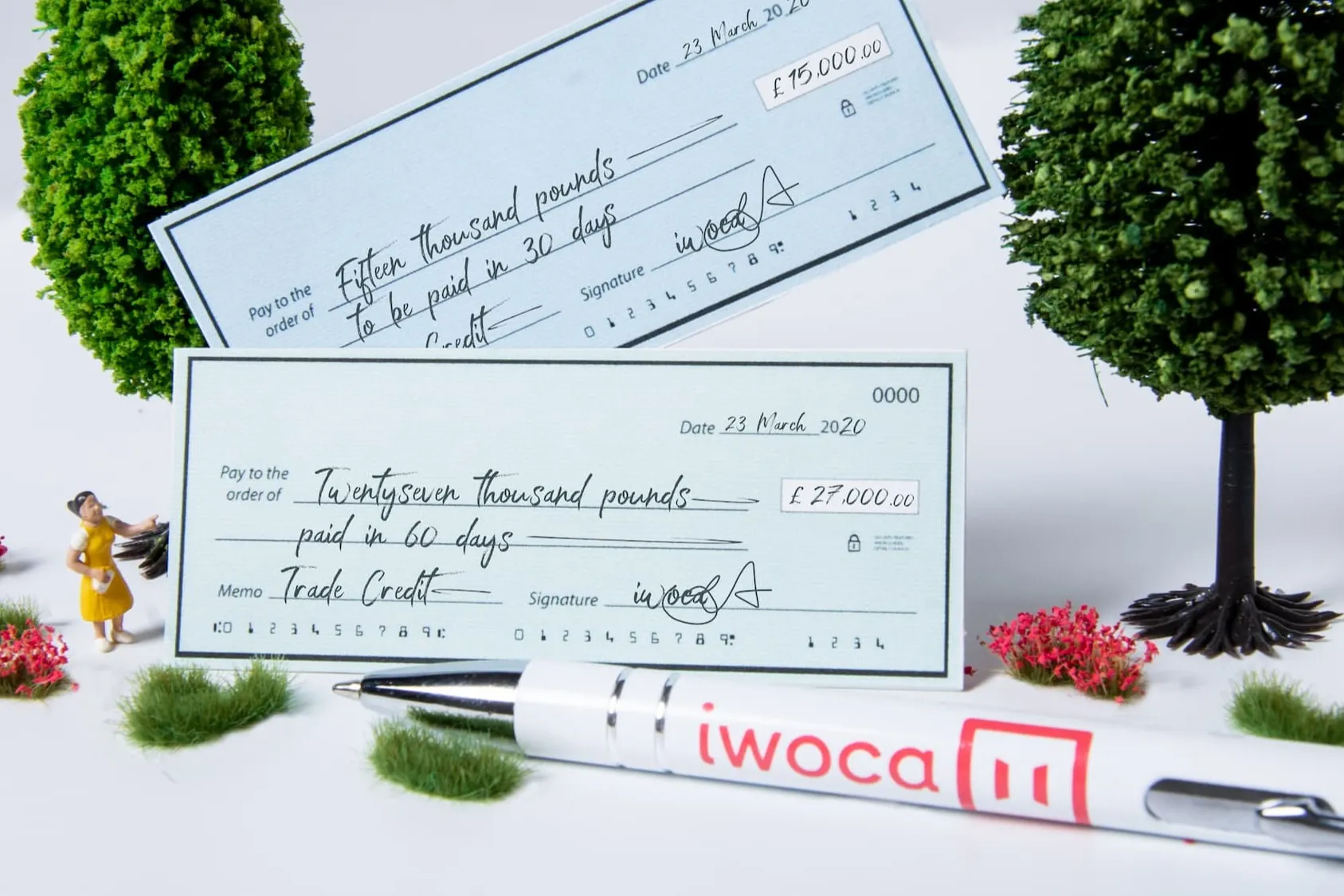
Offering payment terms is a sales decision before it's a finance one. Our 2024 research with Cebr found that 48% of business customers have avoided a supplier, or considered it, because its payment terms were short or non-existent. Plenty of suppliers have moved: the share offering terms longer than 60 days went from 7% in 2020 to 17% in 2024. If you sell to businesses that are themselves waiting to be paid, your terms are part of your price.
What decides how you do it is who loses the money when a customer doesn't pay. Give terms straight off your own balance sheet and that's you, holding the debt on goods you've already shipped. Use a provider that pays you at the point of sale and the risk sits with them instead. iwocaPay works that way: your trade customer can pay now or spread it over 30 days, three months, or 12 months, we pay you upfront either way, and you choose whether to absorb the cost or pass it on.
Sometimes you need neither. If the problem is one business paying late rather than everyone paying slowly, you can charge statutory interest of 8% plus the Bank of England base rate on a late commercial payment. An agreed payment date should usually fall within 60 days, and anything longer has to be fair to both sides. Putting the interest on an invoice sometimes changes a payer's habits on its own, and it costs you nothing to do.
You're more likely to need finance because of the wait than because you're growing. You've done the work, the invoice is approved, and the money is a month or two away, while payroll runs monthly and your own suppliers want paying now.
An iwoca Flexi-Loan is a business loan with flexible repayment options for UK limited companies, and it's built for that shape of problem. If you're waiting on an invoice, a Flexi-Loan can cover the gap, and you can clear it with no early repayment fee once your customer pays. You choose a fixed term of between 12 months and five years, so you know what you're committing to, and that fee-free early repayment is why many of our customers only take out our finance for a few weeks, or even days.
Flexi-Loan in action: VCare24
Victoria Simpson's social care business waits 30 to 60 days to be paid by local authorities, while 200 staff are paid monthly. She draws around £200,000 against payroll and repays it within a week as the money comes in.
This bites hardest if you sell to a handful of large customers, where one invoice settled late is most of a month's cash, and if your own costs are fixed and fall due every month.
{{iwoca-pay-cta="/components"}}
iwoca is one of Europe's leading non-bank lenders. Since 2012, we've lent over £4.5 billion to 100,000 small and medium-sized businesses in the UK and Germany.
iwoca has won a number of awards, including Moneynet's best small business lender (2024) and best small business provider (2025). We've also been featured in major media outlets including The Independent, Forbes and the Financial Times.
Borrow £1,000 to £1 million to cover a gap, buy stock or take on your next order. Apply in five minutes and seee what you qualify for.
Borrow £1,000 to £1 million to cover a gap, buy stock or take on your next order. Apply in five minutes and seee what you qualify for.